September 14, 2026 · 5 min read
Will It Leak? A Practical Guide to Crackle Glaze (Kannyu 貫入) in Japanese Vases
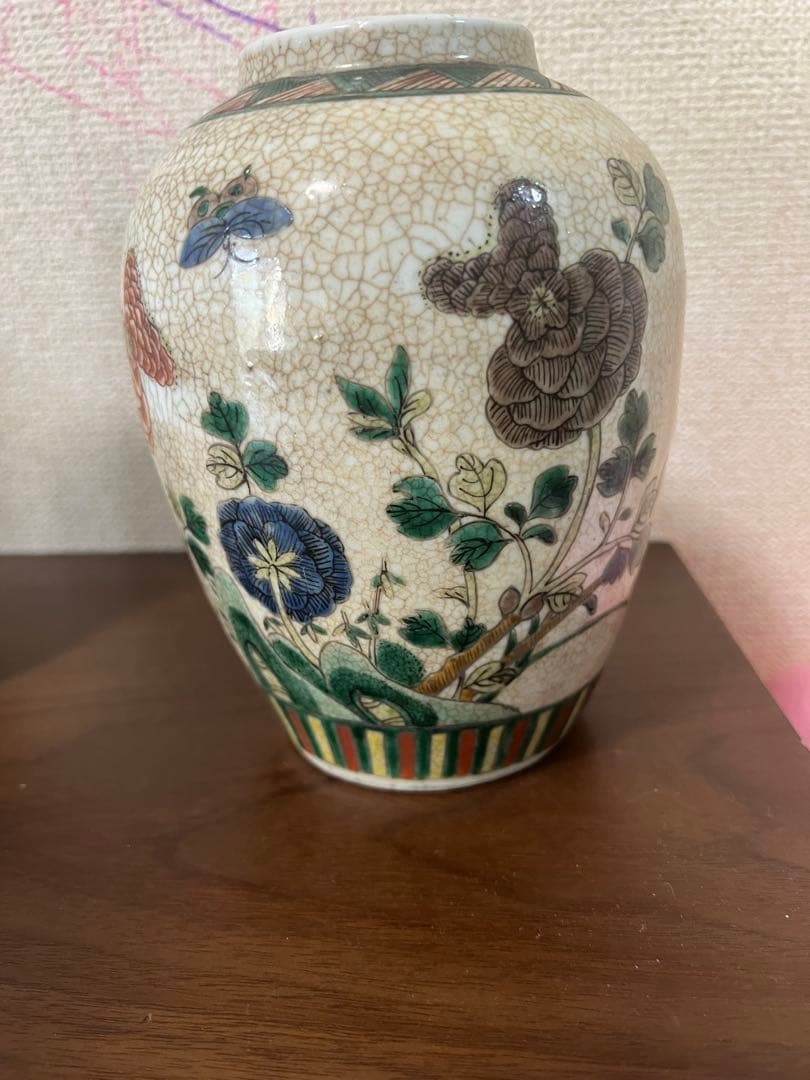
The first time you hold a Japanese crackle glaze vase in daylight, you will find yourself tilting it. A web of fine lines runs across the surface — some hairline and colorless, some stained the color of weak tea. They look like damage. They are not.
In Japanese ceramics this network has a name: kannyu (貫入). It is one of the oldest deliberate effects in the potter's vocabulary, and understanding it changes a vase from something you worry about into something you look forward to.
What crackle glaze actually is
A glaze is glass. A clay body is not. When a finished piece cools in the kiln, the glaze and the clay beneath it contract at different rates. If the glaze shrinks faster than the body it is sitting on, it cannot stretch — so it splits, finely and evenly, into the pattern we call crackle.
That is the whole mechanism. What separates a craft tradition from an accident is control. A potter working in kannyu chooses a clay body and a glaze whose shrinkage rates disagree by a specific amount, then controls the cooling to decide how fine, how wide, and how evenly the network opens. Coarse, dramatic crackle and fine, misty crackle are different intentions, not different luck.
Kannyu vs. crazing: the distinction that matters when you buy
In English ceramics, the word for this same physical event is crazing — and in Western industrial pottery, crazing is a fault. A mass-produced dinner plate that crazes has failed quality control.
The difference is not the crack. The difference is whether it was designed.
- Crazing (defect): unintended, appears after firing or in use, often uneven or concentrated around stress points, and typically accompanies a glaze that was never formulated to craze — including on pieces meant to be dishwashered and sterilised.
- Kannyu (intent): designed into the glaze recipe, appears across the whole glazed surface as a coherent field, and is part of what the maker is selling you.
When you read "crackle glaze" in a Vessel & Kiln listing, it means the second thing. We describe genuine damage — chips, hairline structural cracks through the body, restoration — separately and explicitly, because they are separate things.
So — will it hold water?
Usually yes, and here is the honest version.
Kannyu opens in the glaze layer, not through the wall of the pot. What sits under the glaze decides everything:
- High-fired stoneware and porcelain are vitrified — the clay itself is effectively non-porous. A crackle glaze on a vitrified body holds water normally. Most celadon and porcelain crackle pieces sit here.
- Lower-fired, open-bodied wares — Hagi ware is the famous example — are deliberately soft and porous. Water migrates slowly into the body. This is not a failure; it is the reason Hagi behaves the way it does. In practice it means a Hagi vase may "sweat" faintly, and should be dried thoroughly and never left standing wet on untreated wood or unsealed stone.
Practical rules that cover every crackle-glazed vase we sell:
- Use a glass or metal liner, or a floral frog in a shallow liner, if the piece is antique, porous, or simply precious to you. It costs nothing and removes the question entirely.
- Empty and dry it between arrangements rather than leaving old water standing for weeks.
- Hand wash only. No dishwasher, no bleach, no sudden temperature change — thermal shock is the one thing that turns a decorative crackle into a real crack.
- Set it on a coaster or felt pad if the base is unglazed.
How crackle reads with flowers
This is the part you only learn by living with one.
Fill a crackle vase with water and the glaze changes register. The wet interior darkens the wall from within, and the network — which read as white-on-white in a dry vase — suddenly resolves into depth. Backlight it near a window and the lines catch light on their edges like frost on glass.
For ikebana this is a genuine compositional tool. A dense, fine crackle behaves like a texture: it reads as a soft grey field from two metres away, which means it sits quietly behind busy material — branches, seed heads, anything with a lot of edge. A coarse, widely spaced crackle behaves like a line: it competes with stems, so it wants a minimal arrangement, one or two elements, plenty of negative space.
The general rule: the busier the crackle, the simpler the flowers.
Growing your crackle: intentional aging
Interior design in 2026 has arrived at two phrases — controlled imperfection and intentional aging — describing objects designed to be improved by time rather than protected from it. Japanese potters got there several centuries early.
Because the crackle network is an open capillary system, whatever the vase holds slowly enters the lines and stains them. Over years, a colourless web warms into amber, russet, and eventually a deep tea-brown. In Hagi ware this transformation is celebrated by name — nanabake (七化け), the seven transformations — and a well-used Hagi piece is valued above a pristine one.
You do not need to do anything special. Use the vase. Put flowers in it. The patina you get will be the record of what you put in it, which is the point: it is the one detail of the object that will be yours alone.
Browse the crackle-glazed and Hagi pieces currently in the shop →